Selected professional work and earlier university projects show how I connect architecture, requirements, embedded control, and physical systems. Professional examples are summarized at a high level.
MODEL-BASED ENGINEERING
Digital Twin Foundations For A Battery-Management IC
Built a model-based representation of a battery-management IC from feasibility through production ramp-up, establishing a connected product-model foundation for digital-twin development.
Automotive BMS · Digital Twin Foundations
REQUIREMENTS AUTOMATION
Requirements Traceability Dashboard
Developed a Python and JAMA API dashboard for traceability checks and reporting, supporting assessment preparation in projects involving more than 2,000 requirements and 30 contributors.
Python · Requirements-Tool API Integration
MODEL TRANSFORMATION
SysML Version 1 To Version 2 Transformation
Prototyped transformation concepts using the SysML v2 library to evaluate a more open and automation-friendly modeling approach.
SysML · Exploratory Prototype
MASTER’S THESIS · TU GRAZ / INFINEON · 2018
Cortex-M0 For A Safety-Critical Automotive ASIC
Defined a practical architecture direction for a low-cost ARM Cortex-M0 in an automotive alternator-control IC: firmware for regulation, independent hardware for protection. Backed the recommendation with fault-injection simulation, safety analysis, and requirements traceability.
About the project
The engineering question. How could a cost-sensitive automotive IC use a Cortex-M0 while addressing an ASIL B target for overvoltage protection? My Master’s thesis at TU Graz, conducted with Infineon, investigated which functions belonged in firmware and which needed dedicated hardware, considering chip area, development effort, and the work needed to substantiate safety.
The architecture decision. The study favored running complex regulation functions in firmware under the supervision of simpler, independent hardware safety mechanisms. For the overvoltage case study, this retained the flexibility of the Cortex-M0 without the overhead of duplicating the processor and its supporting resources for a firmware-based safety approach.
From concept to evidence. Combined firmware with C models of the physical circuitry in a closed-loop simulation. Tested normal regulation and injected faults into the voltage-measurement path to demonstrate the independent protection mechanism taking over when firmware received incorrect measurements.
A wider investigation. Examined fault-tolerant processor architectures, hardware and software safety assessment, safety design patterns, Goal Structuring Notation, and verification methods. Connected safety goals to detailed requirements, hardware and software allocations, and verification activities in JAMA; demonstrated change-impact analysis and a reference fault tree.
The contribution. An evidence-based architecture recommendation and a structured foundation for further safety engineering, bringing together embedded development, system design, and requirements management in one industrial case study.
Completed Master’s Thesis · Sehr Gut (Grade 1)
49-second demonstration · Sound optional
SEMINAR PROJECT · TU GRAZ / 2017
WallkerBot: Bernadette
Designed a wall-following research prototype combining PID control, redundant sensing, and environmental monitoring. A PIC controller handled time-critical sensing and actuation, with a Raspberry Pi supporting sensor fusion, supervision, and spoken status reporting.
About the project
Control architecture. A Microchip PIC16F-family controller ran the fast sensing and actuation path, while a serially connected Raspberry Pi supported sensor fusion and higher-level supervision. PID feedback converted wall-distance error into steering corrections, connecting the sensing architecture to the robot’s physical behavior.
Sensor diversity and diagnosis. Sharp infrared proximity sensing around the chassis was complemented by left- and right-side ultrasonic sensing. On the wall-following side, two-out-of-three majority voting combined two digital Sharp channels with an ultrasonic channel. Cross-checks within the digital pair and between infrared and ultrasound applied homogeneous and heterogeneous duplex patterns to detect inconsistent measurements.
Environmental awareness. Flame, smoke/gas, light, and microphone inputs extended the platform beyond navigation. The speaker provided spoken information about sensor and environmental state, together with an audible alarm when fire was detected. Developed for a TU Graz seminar in 2017, the project brought feedback control, diagnostic reasoning, and hardware/software partitioning into one research prototype.
PID Control · Sensor Diversity · Fault-Aware Architecture
33-second demonstration · Sound optional
BACHELOR'S THESIS · ANKARA UNIVERSITY / 2014
Childoid Humanoid Robot
Built a humanoid research platform integrating articulated arms, a mobile base, and partitioned PIC/Raspberry Pi control. Combined responsive sensing and actuation with wireless operation and OpenCV-based eye tracking.
About the project
Architecture and interfaces. A PIC-based controller board handled fast sensing and control functions, while the Raspberry Pi supported wireless communication and higher-level software. A serial interface linked the devices. This allocation kept timing-sensitive control separate from interaction tasks and formed part of the project’s approach to fault-tolerant operation.
Interaction and perception. A Java operator interface enabled wireless control and viewing of system information. The head-mounted tablet also ran an OpenCV-based eye-tracking function; this feature is not shown in the demonstration.
System integration. Developed for my 2014 bachelor’s thesis at Ankara University, Childoid brought mechanisms, actuators, sensor interfaces, power distribution, and software together as one platform. It provided practical experience in interface design, task allocation, and integration across mechanical, electronic, and software boundaries.
Partitioned Control · Wireless Interaction · Computer Vision
26-second demonstration · Sound optional
EARLY UNIVERSITY PROJECT · ROBOT KINEMATICS / 2010
Robotic Arm: Kinematics And Control
Applied forward and inverse kinematics to an articulated servo arm: mapping joint configurations to gripper pose, and calculating candidate joint configurations for a desired position and orientation.
About the project
From geometry to motion. Kinematic transformation matrices represented the chain of joints and links. Forward kinematics mapped a joint configuration to end-effector pose; inverse kinematics sought one or more feasible joint configurations for a specified target pose.
Connecting calculation and hardware. The implementation combined direct servo-position commands, recorded/replayed motion, and kinematic calculations. This linked the mathematical model to the arm’s geometry, actuation, and reachable configurations. The gripper is not fully assembled in the footage.
Built in 2010 during my university years, this was my first practical application of robot kinematics and an early exercise in translating an analytical model into physical behavior.
Forward And Inverse Kinematics · Servo Actuation
23-second demonstration · Sound optional
UNIVERSITY YEARS · COMPETITION ROBOTICS / 2011
Advanced Line-Following Robot
Developed a competition-winning line follower around a PIC18F2550, analog reflectance sensing, and fast PID control. Custom silicone-based tires complemented the controller with the traction needed for sharp, fast turns.
About the project
Line-position estimation. A front-mounted Pololu reflectance array provided analog sensor readings. A weighted average of those responses estimated lateral line position; deviation from a calibrated center became the tracking error for the PID steering loop.
Timing and control. The PIC18F2550 ran at its highest supported clock setting. Firmware execution speed and controller tuning were treated together, shortening the sense–compute–actuate cycle to support rapid correction through sharp bends.
Traction as part of the system. I developed custom silicone-based tire compounds to increase grip, with regular cleaning forming part of the practical track setup. Built during my university years in 2011, The robot won multiple line-following competitions and became a focused exercise in estimation, feedback control, and the mechanical limits of high-speed motion.
Competition Wins · Analog Sensing · PID Control And Traction
 View Photograph ↗
HARDWARE AND SOFTWARE
Mainsail Scanning Prototype
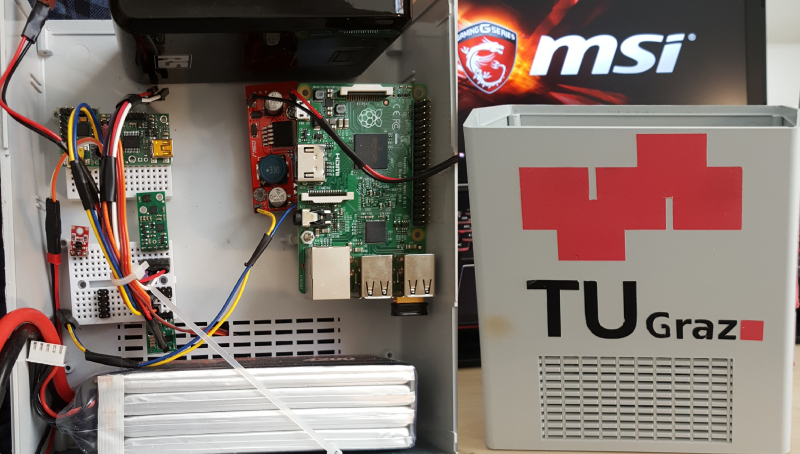
An academic laser-scanning project at TU Graz, investigating mainsail curvature measurement for sailing-route optimization. A practical meeting point between sensing, electronics, and software.
Academic Project · Sensing And Integration
 Explore Catrobat on GitHub ↗
COLLABORATIVE SOFTWARE DEVELOPMENT EXPERIENCE
Catrobat: Android Education Software Team
Catrobat is a nonprofit, open-source project creating free educational apps that help people learn programming by making and sharing interactive stories, games, and animations. As part of its Android education-software student team, I contributed to Java and Android development through agile ticket-based work, code reviews, and iterative delivery.
Catrobat is developed by the free/libre open source non-profit Catrobat project catrobat.org.
Student-Team Contribution

 Architecture And Modeling
 Requirements And ALM
 System Simulation
 Software Foundations
 Automation And Data
 Development Environments
 Operating Systems
 Electronics And PCBs
 Automotive IC Products
 Semiconductor Architecture Knowledge
 Robotics
 RTL And FPGA Prototyping
 Digital Verification
 Safety Concepts And Analysis
 Safety Cases And Assessments
 Verification And Assurance
 Development Rigor
 Quality And Tool Governance
 Firmware Development
 Interfaces And Communication
 Memory Concepts
 Embedded Platforms And Prototyping
 Process And Collaboration
 Version Control
 Technical Communication








 Connect on LinkedIn